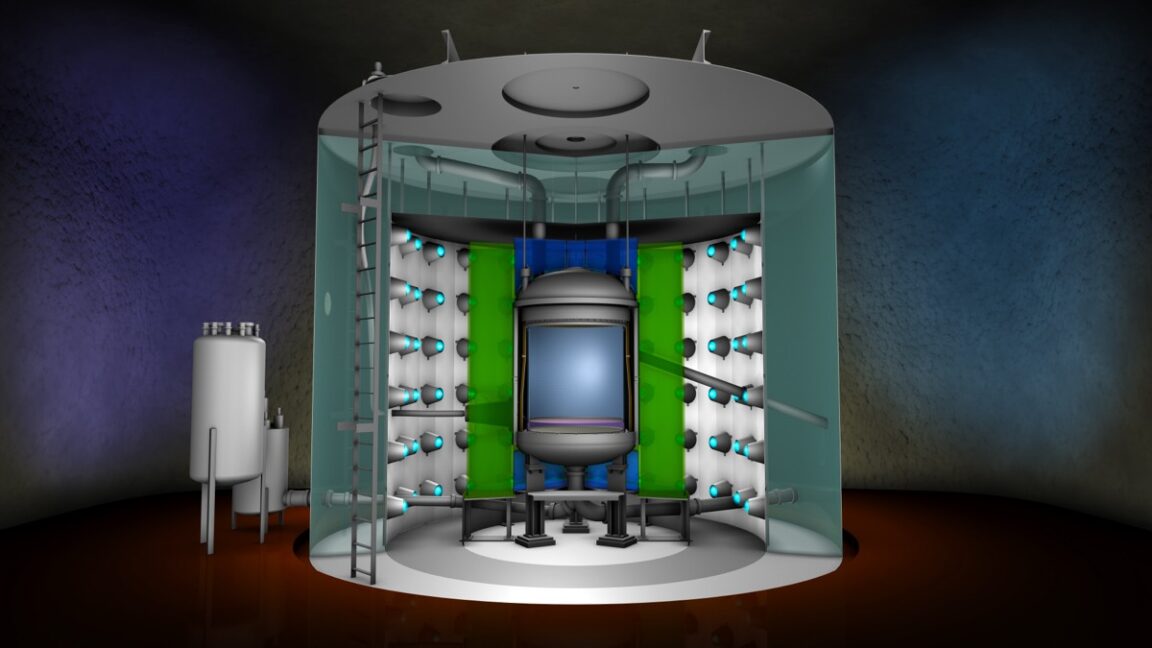
It’s a regrettable reality that there is never enough time to cover all the interesting scientific stories we come across. So every month, we highlight a handful of the best stories that nearly slipped through the cracks. September’s list includes a tantalizing hint of the elusive dark matter at the LUX-ZEPLIN detector; entangled Z bosons at the Large Hadron Collider; possible use of psychoactive substances in the Late Pleistocene; and an intriguing technical description of a telescope attributed to Galileo. A hint of dark matter? Physicists believe dark matter makes up roughly 85 percent of matter in our universe, with the strongest (but not only) candidate being so-called weakly interacting massive particles (WIMPs). But directly detecting WIMPs, or other alternative hypothetical dark matter particles, has eluded physicists for decades. We might have our first glimpse, however, courtesy of the LUX-ZEPLIN detector buried deep in a gold mine in South Dakota. Those potentially exciting results were presented in a scientific talk at the 2026 TeV Particle Astrophysics conference in Japan, with a preprint available on the arXiv. (It has been submitted to Physical Review Letters for peer review.) The announcement came with strong caveats: the signal is just a hint, well below the threshold needed to confirm discovery, and might just be a statistical fluke. Anyone who regularly follows dark matter news knows that past tantalizing anomalies evaporated as more data came in. But the LUX-ZEPLIN team was unable to account for this event and decided to report their result to the broader physics community. They are still collecting data, as is the XENONnT at the Gran Sasso National Laboratory in Italy. And China's PandaX detector is currently being built. Read full article Comments The global technology and hardware manufacturing sector is navigating rapid infrastructural transformation, characterized by aggressive fabrication node transitions, complex supply-chain reconfigurations, and intensifying competition over next-generation computing standards.
The global technology and hardware manufacturing sector is navigating rapid infrastructural transformation, characterized by fabrication node transitions, supply-chain reconfigurations, and intensifying competition over next-generation computing standards.
1. Primary Wire Report & Core Developments
As reported by Ars Technica, the developments surrounding "Research roundup: 6 cool science stories we almost missed" demonstrate how rapidly industrial specifications, enterprise investments, and consumer expectations are evolving in tandem. Industry analysts note that both commercial hardware roadmaps and enterprise software integrations are being recalibrated to accommodate heightened demands for energy efficiency, thermal performance, and computational density.
Technical benchmarks and market indicators highlight several core vectors:
- Architectural Refinement: Optimization of physical component yields and packaging density to maximize operational longevity.
- Supply Chain Synchronization: Multi-tier sourcing strategies designed to insulate critical assembly pipelines from localized geopolitical or maritime logistics disruptions.
- Consumer & Enterprise Integration: Seamless software-hardware co-design enabling advanced features with minimal latency and power penalty.
2. Background Context & Systemic Precedents
The historical trajectory of contemporary consumer and enterprise hardware reflects continuous engineering against thermodynamic and physical scaling limits. As conventional planar semiconductor scaling slowed, leading hardware manufacturers shifted toward heterogeneous chiplet packaging, advanced 3D stacking, and custom application-specific silicon.
Simultaneously, enterprise infrastructure—including hyperscale data center facilities and high-performance computing centers—has confronted heightened municipal and regulatory review regarding water consumption, electrical grid strain, and community environmental impact.
3. Economic Implications & Market Reactions
Market participants and equity analysts are closely monitoring capital expenditures related to these hardware and infrastructure initiatives. Corporate commitments involving significant capital outlays to local communities, power utilities, and supply-chain partners underscore the necessity of securing operational stability in an increasingly scrutinized regulatory environment.
Key commercial factors currently influencing strategic roadmaps include:
- Capital Allocation Discipline: Balancing research and development expenditures against corporate margins and macroeconomic conditions.
- Component Localization: Incentives provided by sovereign industrial programs encouraging domestic assembly and high-tech manufacturing hubs.
- Secondary Market Impact: Upstream demand surges for specialized materials, rare-earth elements, and advanced testing instrumentation.
4. Policy, Compliance & Forward-Looking Outlook
Regulatory scrutiny surrounding hardware standardization, right-to-repair legislation, and data center energy permits is expanding across major industrial markets. Municipal authorities and environmental regulators are requiring transparent reporting on carbon intensity and localized resource utilization.
As engineering teams prepare their upcoming product portfolios and quarterly disclosures, strategic success will hinge on executing verified technical deliveries while proactively addressing societal and regulatory obligations.