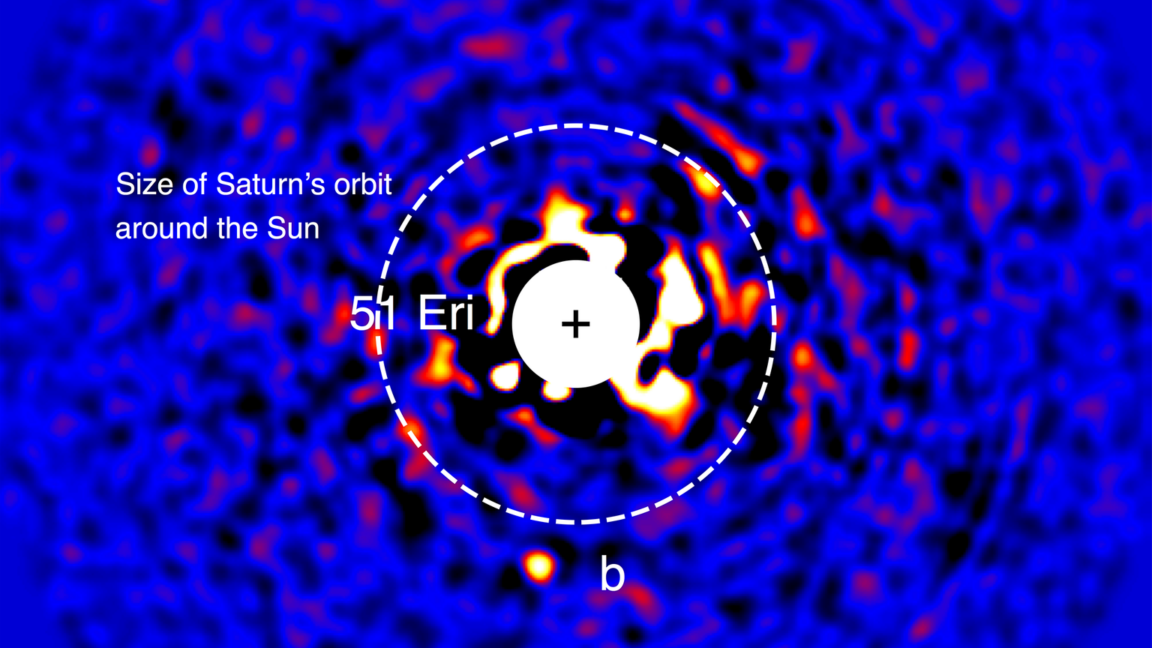
With a huge and still-growing catalog of exoplanets, researchers are anxious to take the next steps: trying to infer what conditions are like on them, either by imaging them directly or by capturing the light that has passed through their atmosphere. Both are substantial challenges, given the presence of stars that are far, far brighter than light that has come to us via the planet. While telescopes can be fitted with devices called coronagraphs that block out much of a star's light, there are limits to their effectiveness, caused by noise from subtle variations in the telescope's configuration and pointing between observations. Now, researchers have developed a new software package that optimizes a physical model of the telescope in a way that allows us to better model these differences, producing low-noise imaging of exoplanets. Point spreads Central to this work is the concept of a point spread function. If you use a telescope to image a single point of light, it will not appear that way in the actual image. Instead, it will be slightly blurry and spread out, due to imperfections in the telescope hardware and the limits of our ability to keep it pointed accurately through the time it takes to image something. The mathematical description of how a telescope distorts a point of light is called its point spread function.
Software squeezes more data out of Webb Telescope for imaging exoplanets
With a huge and still-growing catalog of exoplanets, researchers are anxious to take the next steps: trying to infer what conditions are like on them,...
- Primary Wire Report: With a huge and still-growing catalog of exoplanets, researchers are anxious to take the next steps: trying to infer what conditions are like on them,...
- Desk & Verification: Normalized under Science & Discovery desk via Ars Technica.
- Classification Status: DEVELOPING wire dispatches verified against institutional sources.
John Timmer
ContributorContributing Reporter via Ars Technica
This article has been aggregated and formatted under Chronicle Global's editorial standards. Primary source reporting is attributed to originating news services and verified against public records.
Direct primary wire transmission originated by Ars Technica.
Source Transparency & Verification Dossier
Format: DEVELOPING
Retrieved / Published: Nov 5, 2026, 07:59 PM UTC
Content normalized through Chronicle Ingestion Engine.
Editorial StandardsThe Chronicle Morning Intelligence Briefing
Independent global intelligence and primary wire coverage. High-signal empirical dispatches delivered daily at 06:00 UTC.
Related Coverage & Developing Updates

Different text genres help doctoral students adapt their writing to reach new readers
An academic abstract, a blog post and a public outreach article all place different demands on the writer.

The introduction of a medieval public health system exposed the population to roundworm
Medieval health and sanitation efforts involved deliberate interventions; however, some of these measures had the opposite effect, leading to an increased...

The migration that transformed Africa's languages, genes, and cultures
It’s not easy to extract iron from its ore.